
Ask most homeowners what’s on their roof, and you’ll get one answer: shingles. That’s it. That’s the whole model, a roof as a bunch of shingles nailed to some wood, and as long as they’re not curling up or falling off, everything’s fine.
It’s a reasonable guess. It’s also missing about five other components, each doing a job the shingles can’t do alone.
A roof isn’t a material. It’s a system, a stack of layers, each with a specific purpose, working together to keep water, heat, and moisture on the correct sides of your ceiling. Understanding that stack doesn’t just satisfy curiosity. It changes how you talk to a roofer, how you read an inspection report, and how you figure out where a leak is actually coming from instead of just where it’s showing up.
A roof is a system, not a material
Here’s the mental shift worth making: when a roof fails, it’s rarely because “the roof” failed. It’s because one specific layer in that stack got damaged, aged out, or was never installed correctly in the first place, while the other layers kept doing their job around it.
That distinction matters. A cracked shingle isn’t automatically a leak. A missing piece of flashing might be. A roof that’s “only” 12 years old can fail faster than one that’s 20, depending on what’s happening in the layers you can’t see. Once you know what those layers are and what each one is responsible for, a lot of confusing roofing advice starts making a lot more sense.
So let’s open it up.
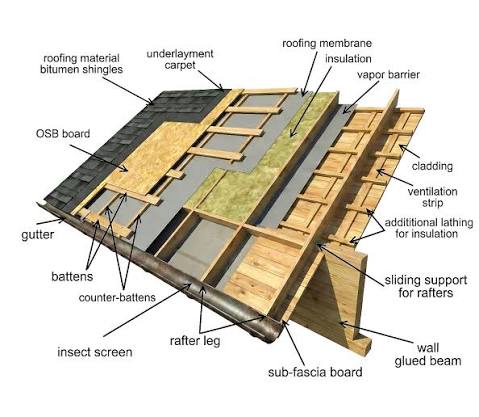
A cutaway view like this is a good reminder that “the roof” is really several separate systems stacked on top of each other, structure, waterproofing, and finish, each doing different work.
The layers, one at a time
Roof deck (the sheathing)
This is the foundation, literally. The roof deck is a layer of structural panels, almost always plywood or OSB (oriented strand board), nailed across the rafters or trusses that frame the roof. It’s the surface every other layer attaches to.
The deck’s job is simple to state and important to get right: give the roof a solid, continuous, flat surface. If the deck sags, rots, or has gaps, nothing you put on top of it, no matter how expensive, will perform the way it’s supposed to. Water damage, poor ventilation, or old age can cause deck panels to soften or delaminate, and that’s a structural problem, not a cosmetic one.
Underlayment (the backup plan)
Right on top of the deck goes the underlayment, a water-resistant layer, usually synthetic material or asphalt-saturated felt, that gets rolled out before the shingles ever go on.
Here’s the part people usually don’t expect: shingles alone are not fully waterproof. They’re designed to shed the vast majority of water, but wind-driven rain, ice, or small gaps can let some moisture through. Underlayment is the layer that catches it. It’s the roof’s insurance policy, quietly doing nothing most of the time, and doing all the work on the one day it matters.
Drip edge (the small piece with a big job)
Drip edge is a thin strip of metal installed along the edges of the roof, at the eaves and often the rakes (the sloped side edges). It’s easy to overlook because it’s small, but its job is precise: it directs water off the roof and into the gutters instead of letting it curl back underneath the edge and into the fascia or deck.
Without drip edge, water can wick backward along the roof’s edge through capillary action, a slow, unglamorous kind of damage that shows up as rot in the fascia board years later, long after anyone would think to blame “the roof.”
Flashing (the leak-prevention specialist)
If underlayment is the roof’s general insurance policy, flashing is the specialist coverage for the roof’s weakest points, anywhere the roof surface meets something that isn’t more roof. Chimneys, skylights, vent pipes, walls, and valleys (where two roof slopes meet) all need flashing.
Flashing is typically metal, bent and installed to create a physical barrier at these transitions, because shingles alone can’t seal an intersection like that. This is genuinely important: a large share of roof leaks don’t come from the open field of shingles at all, they come from flashing that was installed poorly, or that’s worked itself loose over time.
Shingles (the layer everyone can see)
Finally, the part everyone already knows: the shingles (or your roofing material of choice: tile, metal panels, wood shakes). This is the primary water-shedding layer and the one that takes the brunt of sun, wind, and weather.
Shingles are designed to overlap in a specific pattern so that water always has a downhill path to follow, off the roof, without ever having the opportunity to sit still or work its way sideways. It’s a deceptively simple idea — sheet water downhill, always — and almost every shingle installation detail exists to protect that principle.
Ridge and ventilation (how the roof breathes)
At the very top of the roof, where two slopes meet, most roofs have a ridge vent, a gap covered by a specialized cap that lets warm, moist air escape from the attic below.
This isn’t just a comfort feature. Attics need airflow. Without it, heat and moisture get trapped underneath the deck, which can warp wood, degrade shingles from below, and create conditions for mold, all invisible from the ground. Ventilation is usually paired with intake vents lower on the roof (often at the soffits) so air can flow in low and out high, continuously.
Gutters and downspouts (where the water actually goes)
Not technically part of the roof surface, but very much part of the system: gutters catch the water the drip edge just directed off the roof, and downspouts carry it away from the foundation. A roof can do everything right and still cause water problems if the gutters are clogged, sagging, or missing. The water has to go somewhere, and “next to your foundation” is not the answer anyone wants.
How the layers work together
Put it all together and the logic is straightforward: shingles shed the majority of the water. Underlayment catches what gets past them. Drip edge and flashing handle the edges and intersections where water is most likely to sneak in. Ventilation keeps the whole system dry from underneath, not just on top. And gutters carry the water away once it’s done its job leaving the roof.
Each layer is covering for the others’ blind spots. That’s what makes it a system instead of just a pile of materials.
Why this matters when something goes wrong
Here’s where all of this becomes genuinely useful. When a homeowner sees a water stain on the ceiling, the instinct is to blame “the roof” as one big, vague thing. But once you know the anatomy, you can ask better questions: Is this near a chimney or vent, which points to flashing? Is it happening during wind-driven rain specifically, which might point to underlayment doing exactly the job it was designed for, just not perfectly? Is it near the edge of the roof, which might mean drip edge or fascia?
None of this replaces a proper inspection. But it changes the conversation from “my roof is leaking, please fix it” to an actual diagnostic starting point, which tends to get you a faster, more accurate answer, and makes it a lot easier to tell a thorough professional from a rushed one.
Next time you’re standing under your own roof, or looking up at the attic hatch, it’s worth remembering: what’s up there isn’t one thing. It’s a small, quiet team of parts, each with one job, working together to keep the weather exactly where it belongs. Outside.