
“25-year shingles.” “30-year roof.” You’ve seen the number before, probably on a sample board at a hardware store or in a sales brochure. It sounds like a promise. It isn’t.
That number comes from a lab test, not a warranty on your specific house. The real question isn’t “what’s the number”, it’s “what actually determines the number for my roof.” That’s a more useful question, and it has a real answer.
Why a single number is misleading
Manufacturer lifespan ratings come from accelerated aging tests: controlled conditions, standardized exposure, a formula that extrapolates from a few weeks of intense testing to a multi-decade estimate. It’s a reasonable way to compare products on a shelf. It is not a simulation of your roof, your climate, or your attic.
That’s why two roofs with the exact same shingle, from the exact same batch, can age completely differently depending on where they are and how they were installed. As covered in The Anatomy of a Roof and The Weak Points, a roof’s performance was never just about the shingle on top, it’s a full system, and lifespan is a system-level outcome, not a single-material spec.
So instead of chasing one number, it’s more useful to understand the variables that move that number up or down.
The factors that actually determine lifespan
Material choice
This is the variable everyone focuses on, and it does matter, just as one input among several. Different materials have meaningfully different realistic lifespan ranges:
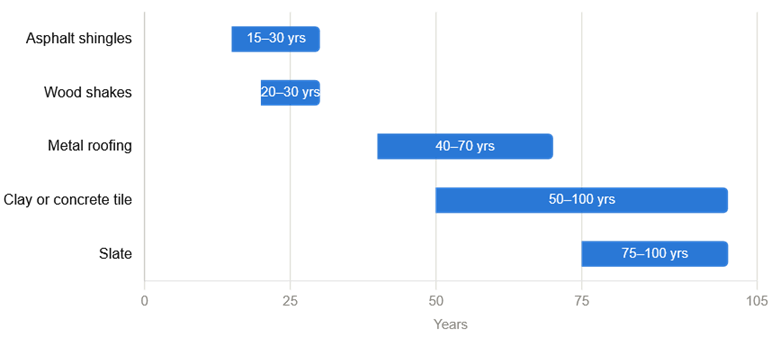
Notice these are ranges, not single numbers, and notice how wide some of them are. That spread is the whole point of this post: material sets the ceiling, but everything below determines how close you get to it.
Installation quality
Two identical materials, installed by two different crews, can age at very different rates. Nailing pattern, proper ventilation setup, and correctly executed flashing (the transitions covered in The Weak Points) all directly affect how long a roof performs well. A premium material with a rushed installation will often underperform a mid-range material installed carefully and correctly.
Climate exposure
Heat, UV intensity, humidity, freeze-thaw cycling, high wind, and hail all age roofing materials, but they do it in different ways. Intense sun degrades asphalt’s oils and causes granule loss. Freeze-thaw cycles stress materials through repeated expansion and contraction. Wind tests the fastening system. This is a big enough topic that it deserves its own deeper look at how a specific climate shapes roof lifespan, but the short version is: the same shingle rated for 30 years will age differently in a hot, humid climate than in a mild one.
Ventilation and attic conditions
As covered in the anatomy of a roof, ridge and soffit vents let hot, moist air escape from the attic. When that airflow isn’t working properly, heat and moisture get trapped underneath the deck, and that trapped heat cooks the roofing material from below, regardless of how good the material is on top. Poor attic ventilation is one of the most common, and most invisible, reasons a roof underperforms its rating.
Roof color and reflectivity
Darker roofing materials absorb more solar heat than lighter ones. That extra heat accelerates the aging process for materials like asphalt, which are sensitive to thermal cycling. This doesn’t mean dark roofs are a bad choice, but it’s one more variable in the lifespan equation, particularly in hot, sunny climates.
Maintenance and inspection history
A lifted shingle, a small gap in flashing, a cracked vent boot, none of these are urgent on day one. But left alone for years, small issues compound. Water finds its way into the roof deck, moisture leads to rot or mold, and a manageable repair becomes a much larger one. A well-maintained roof with a few small repairs along the way will often outlast a technically identical roof that was left completely alone.
Roof slope and design complexity
A simple roof with few penetrations and a straightforward slope has fewer opportunities for water to find its way in. A roof with many valleys, dormers, skylights, and transitions (the failure points covered in The Weak Points) has more places where things can go wrong, which can shorten a roof’s effective service life even if every individual component is rated for decades.
Lifespan is a range, not a deadline
None of this means a roof falls apart the day it crosses its rated year. Roofing materials degrade gradually, losing granules, becoming more brittle, sealing less effectively, long before they fail outright. That gradual decline is exactly why the factors above matter: they determine how fast that decline happens, not just when a clock runs out.
This cuts both ways. A roof past its “rated” age isn’t automatically a problem, and a roof well within its rated age isn’t automatically fine. What matters is the actual condition, not the number on a brochure from installation day.
What this means practically
Rather than looking up a single number online, it’s more useful to weigh the factors together: What’s the material? How’s the ventilation? What’s the climate like? Has it been maintained, or ignored? A rough answer built from those questions will be far more accurate than any generic search result.
And because gradual decline is the norm rather than sudden failure, regular inspection, especially at the transition points covered in previous posts, matters more than watching the calendar. The roof will usually tell you what condition it’s in, if you know where to look.
The bottom line
The “25-year shingle” question was never really a question about shingles. It’s a question about everything underneath and around them, the deck, the ventilation, the flashing, the climate, and how consistently small issues get addressed. Know those factors, and a lifespan estimate stops being a guess and starts being an informed judgment call. And if you live somewhere with a genuinely demanding climate, some of these factors will matter a lot more than others, which is exactly the next thing worth digging into.